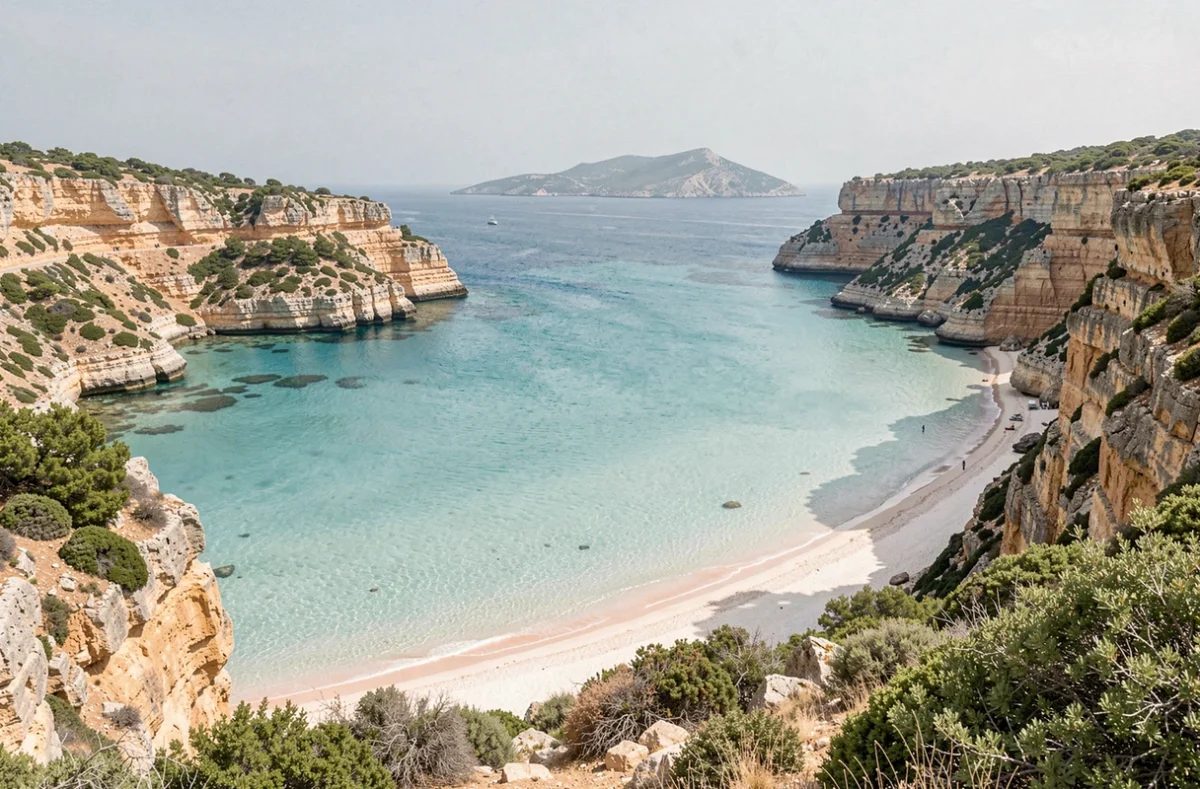
Balos, in the far northwest of Crete, concentrates an unusual density of historical narratives over just a few hundred meters of sand. Between the fortress of Gramvousa, the Cretan insurgents of the 19th century, and the turquoise waters of the lagoon, the boundary between myth and documented fact easily blurs. Which elements pertain to the verified episode, and which are more a product of tourism construction?
Gramvousa and Privateering: Timeline of a Real Episode
Most content refers to “pirates of Gramvousa” without distinguishing privateering from piracy. The difference is, however, documented. In August 1825, Cretan insurgents took the Venetian fortress of Gramvousa, the island facing the lagoon of Balos. For more than two years, this position served as a base for privateering operations against Ottoman and merchant ships.
The occupants did not limit themselves to maritime raids. They are said to have established a school and a church on the island, which places the episode within a project of organized resistance, not in a simple den of buccaneers. The legends of Balos beach find their factual basis here, even if oral transmission has gradually transformed these privateers into romanticized pirates.
| Element of the Narrative | Documented Historical Basis | Common Legendary Distortion |
|---|---|---|
| Capture of the fortress (August 1825) | Verified episode of the Cretan War of Independence | Presented as a pirate den without political context |
| Privateering operations (1825-1828) | Maritime privateering targeting Ottoman and merchant ships | Confused with piracy for personal gain |
| School and church on Gramvousa | Establishments mentioned by historical sources | Rarely cited, as they contradict the image of the pirate |
| Buried treasures on the island | No known archaeological evidence | Recurring tale in tourist guides |

Mythologized Landscape of Balos: What Geology Produces and What Marketing Embellishes
The lagoon of Balos owes its color palette to a precise geological configuration. The shallow depth of water between the peninsula of Gramvousa and the Cretan coast creates variations of blue and green visible from the descent path. This phenomenon, purely optical, nonetheless fuels an almost supernatural register in tourist descriptions.
The absence of a pontoon at disembarkation alters the actual experience of the site. Some boats drop passengers about fifty meters from the shore. One must then walk in the water or take a small boat to reach the beach. This detail, rarely mentioned in promotional content, contrasts with the image of a paradisiacal lagoon accessible without effort.
The legend of the place also relies on a gap between photographs (taken early in the morning, off-season) and the reality of peak summer attendance. The grouped arrivals of boats saturate the disembarkation area, where visitors cross paths between arrival and departure.
Attendance and Accommodation Capacity: The Numbers Behind the Myth of the Preserved Place
Balos is often presented as a wild jewel of Crete. Recent data nuances this image. The municipality of Kissamos is considering a digital platform to manage time slots and visitor quotas, with a scenario anticipating about 1,200 people per three-hour slot. Implementation is planned for as early as the 2027 season.
The number of sunbeds has been reduced from about 400 to 150, according to an environmental advisor from the municipality of Kissamos (reported by Kathimerini and picked up by Baden24 in September 2026). This reduction is not enough to alleviate the concentration peaks related to maritime arrivals.
The tension between preservation and tourist attractiveness is now an integral part of the narrative of Balos. The myth of the secret place clashes with attendance that imposes concrete trade-offs:
- The proposed quota of 1,200 people per slot aims to limit site degradation without prohibiting access
- The reduction of sunbeds responds to environmental pressure but does not change the flow of visitors arriving by boat
- The current absence of a reservation system leaves the management of flow to cruise operators, who have no economic incentive to limit their rotations
Narratives of Cretan Resistance and Identity Construction Around Balos
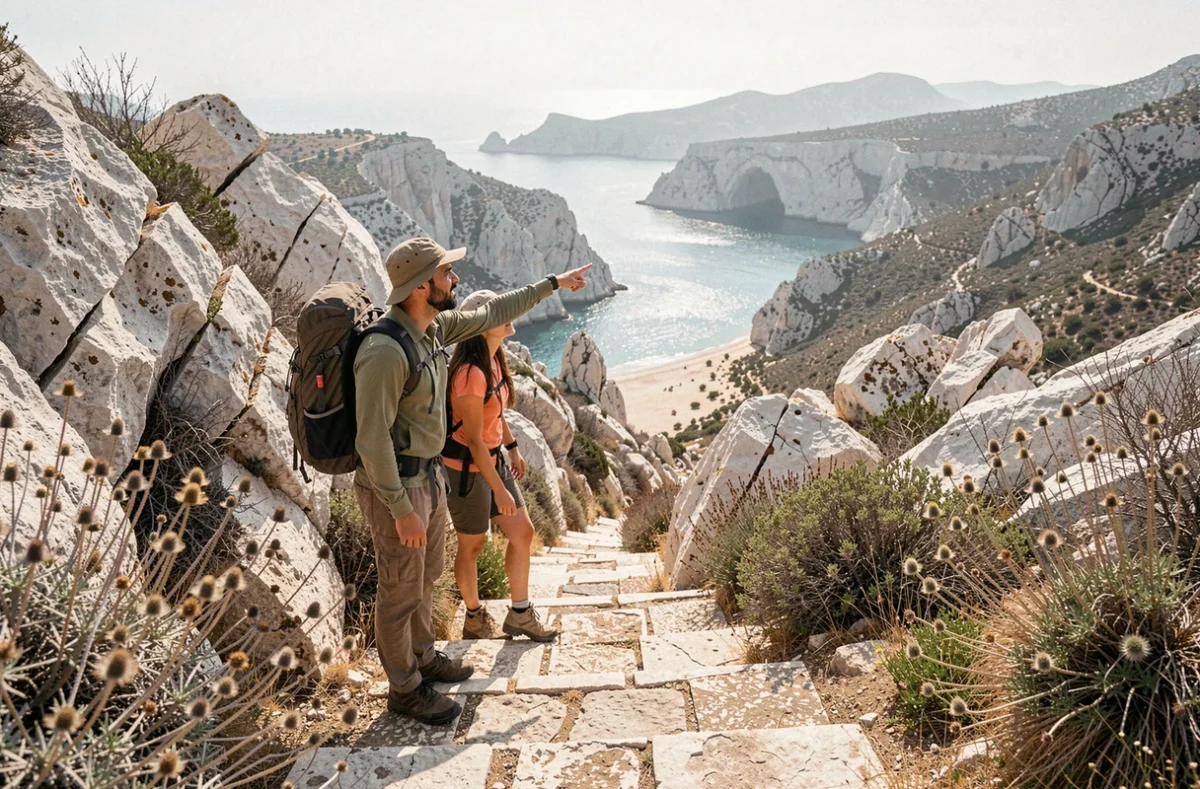
The legends of Balos are not limited to pirates. The fortress of Gramvousa is part of a broader network of sites related to Cretan resistance against Ottoman occupation. The island of Gramvousa, with its Venetian fort, has served as a symbol of autonomy long before becoming a cruise stop.
The transformation of a military stronghold into a tourist attraction illustrates a classic mechanism of heritage-making. The heroic narrative of the 1825 capture now overlaps with selfies taken in front of the ruins. Local guides willingly mix historical episodes with unverifiable anecdotes about hidden treasures or nocturnal apparitions.
This layering of narrative layers—historical, legendary, promotional—precisely defines Balos compared to other Cretan beaches like Elafonisi or Preveli. The latter rely more on their natural beauty. Balos, on the other hand, draws a significant part of its attractiveness from a narrative transmitted and reconstructed over the decades.
The site functions as a palimpsest where each era has deposited its version. The insurgents of 1825 saw it as a strategic point. Travelers of the 20th century found a pristine landscape. Contemporary tourism operators project a Caribbean lagoon in the Mediterranean. None of these readings are false, but none alone is sufficient to account for the place.
The question of accommodation capacity, with its quotas and digital slots, could paradoxically enhance the mythical dimension of Balos. A place whose access becomes limited gains in perceived rarity, and rarity nourishes the myth as surely as history does.