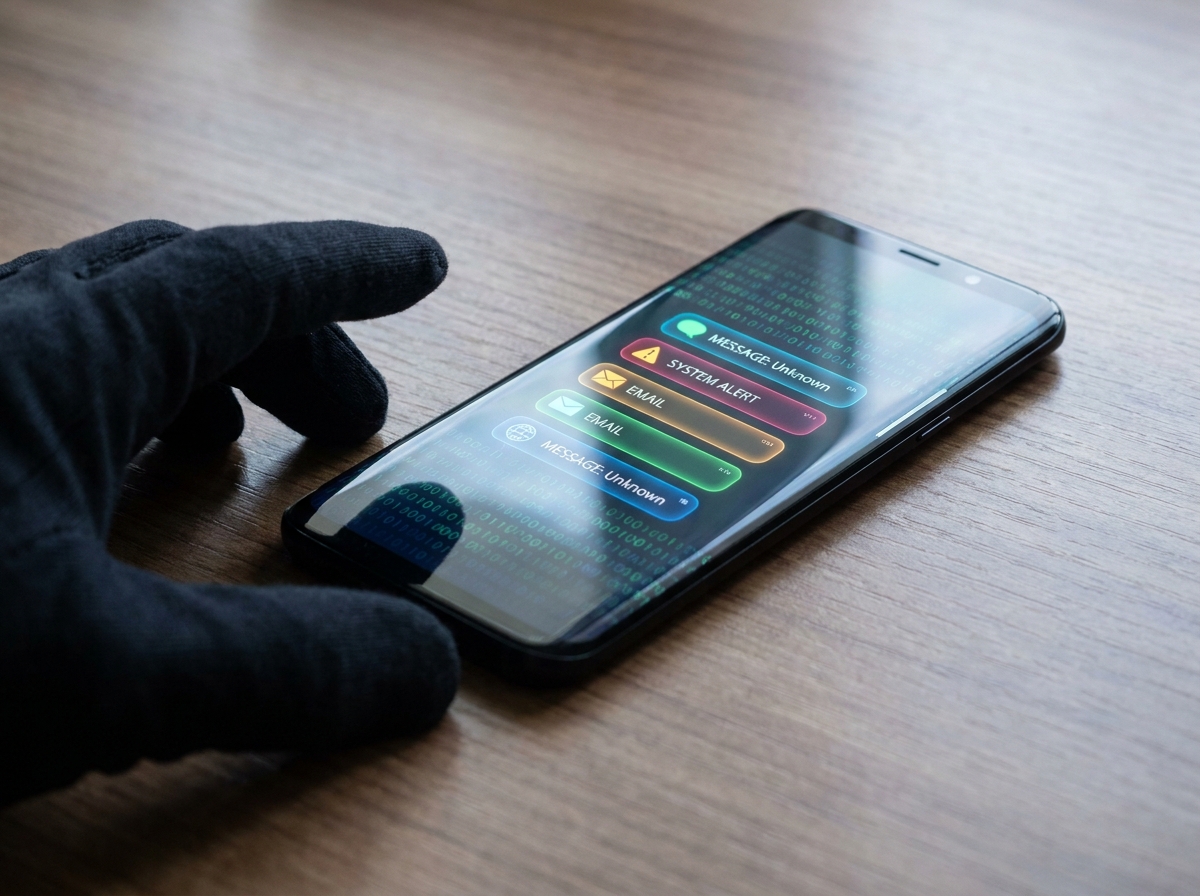
Hacking a phone refers to any operation that allows access to the data or functions of a mobile device without the owner’s permission. The techniques exploited by cybercriminals target both software vulnerabilities and user behavior, and their sophistication increases as protections strengthen.
Bluetooth Low Energy and wearables: an underestimated attack surface
Mobile security audits generally focus on the operating system and installed applications. Connected devices that revolve around the phone (watches, bracelets, headphones) often remain outside the analyzed perimeter.
Field experience reports from pentesters indicate an increasing effectiveness of command injection attacks via Bluetooth Low Energy (BLE) on these wearables. Once compromised, the accessory serves as a gateway to the phone it is paired with.
The BLE protocol, designed to minimize energy consumption, has few robust authentication mechanisms by default. When a device accepts incoming connections without strict validation, an attacker nearby can inject themselves. This vector is even more discreet as no notification appears on the phone’s screen. To delve deeper into how to hack a phone in 2024 by exploiting this type of vulnerability, the technical documentation details the usual steps of a BLE intrusion.
Mobile phishing and sideloading: the dominant infection vectors
Phishing remains the most common entry point. On mobile, it takes specific forms: fraudulent SMS (smishing), malicious QR codes displayed in public spaces, or push notifications mimicking a legitimate application.
The success of these attacks relies less on the technique than on the manufactured urgency. A message imitating a delivery service or a banking alert prompts the user to click before thinking. The link redirects to a page that collects credentials or installs malware.
The effect of the Digital Markets Act on sideloading
Since the DMA came into effect in March 2024, Apple and Google are required to allow the installation of applications from alternative stores. This opening has led to an increase in malware distributed via unverified platforms.
On Android, sideloading already existed, but the regulatory expansion to iOS has created a new exploitation ground. Malicious applications installed outside the official store evade the automated checks of Google Play Protect or the App Store Review.
- Always check the publisher and the permissions requested before installing an application from a third-party store
- Disable the “unknown sources” option on Android when it is not necessary
- On iOS, do not allow configuration profiles from unidentified sources
Hacking on Android vs. iOS: different success rates
Not all mobile systems present the same level of exposure. Hacking attempts on Android show a significantly higher success rate than on iOS, due to structural differences between the two platforms.
Android relies on a fragmented ecosystem: dozens of manufacturers apply security patches with varying delays. Some devices stop receiving updates less than two years after their release.
iOS benefits from vertical control (hardware and software designed by Apple), which reduces the attack surface. Rooting on Android opens full access to the file system, making the installation of spyware trivial. Jailbreaking an iPhone, which is more complex, has gradually lost reliability on recent versions of the system.
Countermeasures based on AI embedded in smartphones
Manufacturers are now integrating machine learning models directly into the phone’s security chip. These systems analyze application and network behavior in real-time to detect anomalies.
Google Play Protect uses an on-device behavioral analysis engine that monitors suspicious system calls. Apple has deployed a similar mechanism in its Secure Enclave, capable of detecting attempts to extract biometric data. Local behavioral analysis avoids transmitting data to a remote server, which limits the risk of leaks during the detection process itself.
Limits against state-sponsored attacks
These protections are calibrated to block common threats: malicious applications, phishing attempts, known exploits. Against attackers with state resources, their effectiveness drops.
“Zero-click” tools, capable of compromising a phone without any user interaction, exploit non-public vulnerabilities (zero-day). Embedded AI models, trained on known malicious behaviors, do not recognize these novel patterns.
- Zero-day exploits bypass behavioral signatures because they have never been observed before
- State-sponsored attackers have budgets that allow them to purchase these vulnerabilities on specialized markets
- Updating embedded AI models depends on the manufacturer’s update cycle, creating a window of exposure
The most reliable protection against this level of threat remains the immediate update of the operating system as soon as a patch is released, combined with a reinforced lockdown mode (such as Apple’s Lockdown Mode) for high-risk profiles.
Mobile security progresses in successive layers, but each new protection generates new workarounds. The human factor, whether it’s a click on a fraudulent link or a poorly configured connected device, remains the link that technology alone cannot fix.