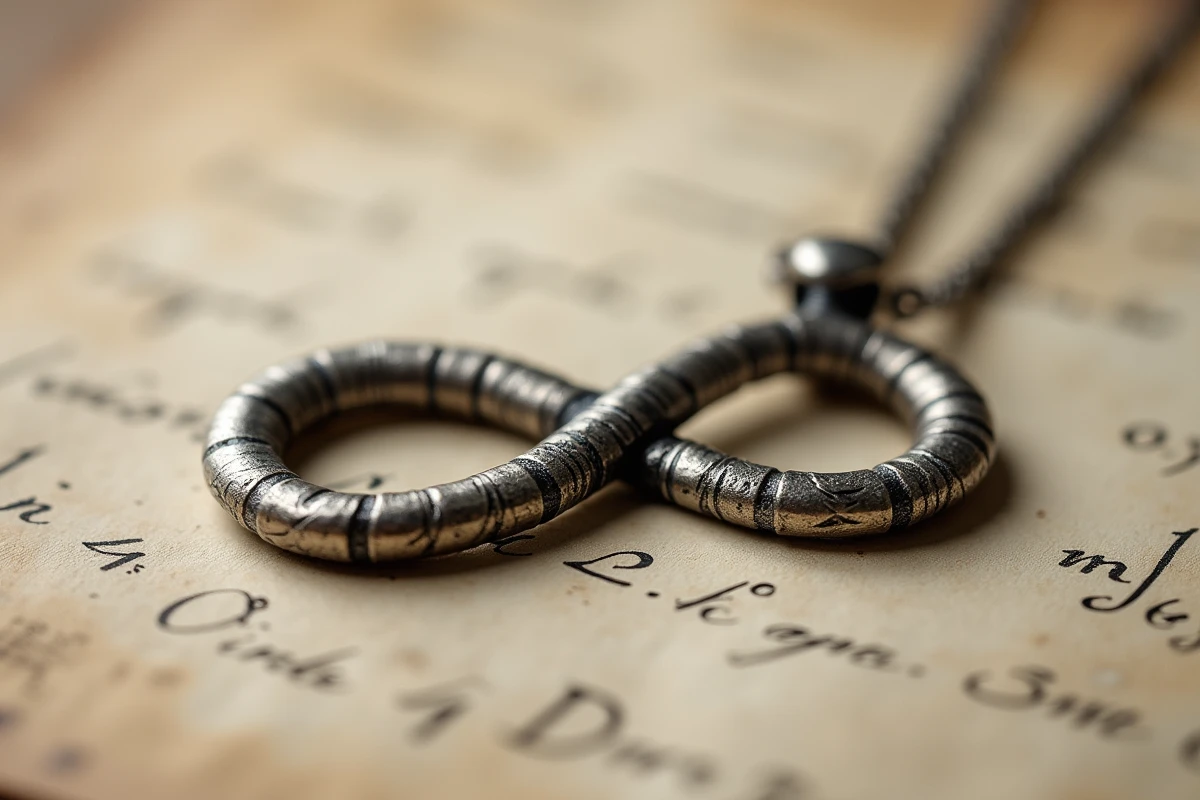
The lemniscate refers to a family of plane curves shaped like a figure eight, not a single trace. This confusion between the geometric curve, the typographic symbol ∞, and the ornamental pattern found in jewelry or tattoos obscures the understanding of the subject. Distinguishing these three registers helps to grasp why this sign has transcended centuries without losing its symbolic weight.
Bernoulli, Booth, and Gerono Lemniscates: Distinct Curves Behind the Same Name
The term lemniscate does not refer to a single equation. Several mathematical curves bear this name, each defined by different geometric properties. The best-known, the Bernoulli lemniscate, is defined as the locus of points for which the product of the distances to two fixed foci remains constant. Its formula in polar coordinates produces a symmetric loop that intersects at its center.
The Gerono lemniscate, on the other hand, is based on a distinct parametric equation and presents a visually similar trace but with different analytical properties. The Booth lemniscate, obtained by inverting a conic, adds yet another variant. Reducing the lemniscate to a “symbol of infinity” ignores this geometric diversity, which alters the interpretation of the sign depending on the context.
We also find the lemniscate in the study of the spirals of Perseus, known since ancient Greece. Perseus defined it as the section of a torus with zero inner radius by a plane. This approach through the section of a surface of revolution predates modern algebraic formulations by several centuries.

Etymology and Adoption of the Infinity Sign in Mathematics
The word lemniscate comes from the Latin lemniscatus, “ornamented with lemniscs,” those ribbons that were tied to the crowns and palms of victors in ancient Rome. The Latin term itself derives from the Greek lemniskos, which referred to ornamental strips. The visual analogy between a knotted ribbon and the mathematical curve has solidified the name.
The article that details the origin and meaning of the infinity symbol reminds us that the symbol ∞ was introduced by the English mathematician John Wallis in his work De sectionibus conicis, published in 1655. Wallis never definitively explained his graphic choice. Several hypotheses coexist: deformation of the Roman numeral for thousand (CIƆ), reference to the lemniscate ribbon, or simply a practical typographic convention.
Jacques Bernoulli popularized the symbol around 1713 by associating it with his work on the curve that now bears his name. This dual paternity, Wallis for the typographic sign and Bernoulli for the curve, explains the frequent amalgamation between the symbol ∞ and the geometric lemniscate, even though they are two distinct objects.
Lemniscate and Cultural Symbolism: A Sign of Connection More Than Esotericism
The symbolic weight of the infinity sign far exceeds the mathematical register. In many cultures, the figure-eight shape evokes cycles, returns, and balance between two polarities. This interpretation traverses traditions without being limited to a single interpretative grid.
- In Western symbolism, the lemniscate often represents the union of opposites: masculine and feminine, matter and spirit, finite and infinite. The central crossing point materializes the transition from one pole to another.
- In the Marseille tarot, the sign appears above the heads of the Magician and Strength, where it indicates an energy in constant circulation rather than occult knowledge.
- In contemporary jewelry and tattoos, the motif functions as a symbol of lasting connection: love, fidelity, family belonging. This trend is more about a culture of connection than a fascination with esotericism.
We observe that the current popularity of the infinity symbol on jewelry and tattoos is based on relational meanings. The wearer chooses this sign to mark an attachment, a commitment, a shared life cycle. The decorative dimension has taken precedence over the mathematical reference, but the symbolic core remains the same: continuity.
Mathematical Form and Decorative Form: Two Different Traces
The version of the infinity symbol used in typography, jewelry, or tattoos is a graphic simplification. The loops are often symmetrical, rounded, and uniform. The Bernoulli lemniscate presents a flatter trace, whose proportions depend on the focal parameter. A piece of jewelry or a tattoo rarely reproduces the exact curve.
This distinction is not trivial. It explains why the same sign can simultaneously function as a mathematical object, ornamental motif, and spiritual symbol without these registers perfectly overlapping.
Lemniscate in Tattoos and Jewelry: Contemporary Meanings
The choice of a tattoo or piece of jewelry in the shape of a lemniscate reflects a desire to wear a readable, compact sign full of meaning. The motif frequently combines with other elements: a name inscribed in the loop, a heart integrated into the trace, a feather extending one of the ends.
These associations are not decorative by chance. Each addition modifies the meaning of the symbol: the name anchors infinity in a specific relationship, the heart directs the interpretation towards eternal love, and the feather evokes freedom or the memory of a deceased loved one.
The infinity sign also serves as a marker of personal harmony. Worn alone, without additions, it refers to a quest for inner balance or the acceptance of life’s cycles. This semantic versatility explains its longevity in trends, where other symbolic motifs fall out of fashion.
The lemniscate remains a rare case of a sign that circulates between mathematics, philosophy, spirituality, and popular culture without ever becoming fixed in any one of these registers. Its strength lies precisely in this ability to accommodate new meanings while retaining a recognizable form throughout.