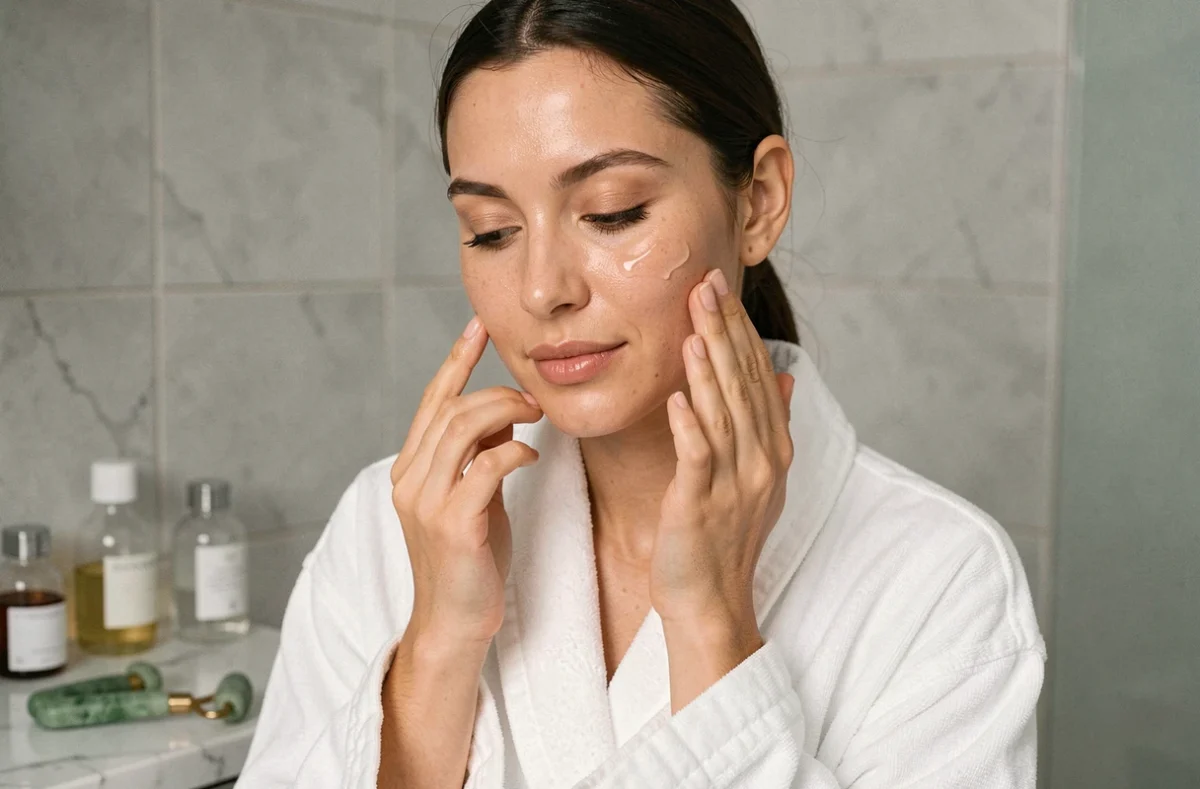
The skin is a living organ whose cellular renewal spans several weeks. Taking care of your skin daily means supporting this cycle by providing three things: appropriate cleansing, sufficient hydration, and protection against external aggressions. The rest, targeted actives, serums, or masks, can be added on this foundation according to the real needs of each skin type.
Skin Barrier and Minimalist Routine: The Foundation to Understand
The most superficial layer of the skin, called the skin barrier, acts as a protective film. It retains water, filters some pollutants, and limits the penetration of irritants. When this barrier is compromised, symptoms appear quickly: tightness, redness, tingling, flaking.
Dermatologists now recommend limiting the daily routine to three steps: a gentle cleanser, a moisturizer, and sun protection. The combination of retinoids, exfoliating acids, scrubs, and cleansing brushes is associated with an increased risk of irritation. The trend is towards “less but better” rather than piling on products.
This approach does not mean giving up actives. It involves adding at most one targeted active according to need (pigmentation, enlarged pores, fine lines) and observing the skin’s reaction before introducing a second one. Adapting your routine based on feedback from your own face remains more reliable than following a rigid protocol found online, as highlighted by the resources available on 1tempspourmapeau.fr.

Facial Cleansing: Choosing Between Micellar Water, Gel, and Oil
Cleansing is the most underestimated step in a facial care routine. A product that is too stripping dissolves the skin’s natural lipids and weakens the skin barrier. A product that is too greasy can leave an occlusive film that promotes imperfections.
Adapting the Cleanser to Your Skin Type
- Oily or combination skin tolerates foaming gels without harsh sulfates, which eliminate excess sebum without causing rebound effects.
- Dry or sensitive skin benefits from using a cleansing oil or milk, which dissolve impurities while leaving a protective lipid film.
- Normal skin can alternate according to the season: a lightweight gel in summer, a cleansing cream in winter when the cold dries it out more.
In the evening, a two-step cleansing (oil followed by a water-based cleanser) is useful for removing residues of sunscreen or makeup. In the morning, a simple splash of lukewarm water or floral water is sufficient in most cases. Cleansing does not mean stripping.
Hydration and Sun Protection: Two Non-Negotiable Steps
Hydration aims to maintain the water level in the upper layers of the skin. It involves two complementary mechanisms: attracting water (humectants like glycerin or hyaluronic acid) and limiting its evaporation (occlusives like shea butter or ceramides).
Moisturizer: Texture and Composition
A lightweight cream is suitable for combination to oily skin. A richer balm protects dry skin, especially in cold weather. Composition matters more than price: an effective moisturizer generally contains a humectant, an emollient, and an occlusive, without needing a list of twenty ingredients.
The daily sun protection is the best-documented anti-aging gesture. UV rays accelerate collagen degradation and promote pigmentation spots. Applying sunscreen every morning, including in winter or on cloudy days, protects the skin much more effectively than an anti-wrinkle serum used in the evening.

The Word “Natural” in Cosmetics: What Regulations Really Cover
Natural beauty is an omnipresent marketing argument, but the term “natural” does not have a strict regulatory definition in France. European regulations govern safety, labeling, and cosmetic claims without setting a general threshold for plant-derived content that would allow claiming “natural” on packaging.
Important oils and certain botanical extracts can cause contact allergies. For sensitive skin, short and fragrance-free formulas are generally safer than a product labeled “100% natural” containing a dozen different essential oils.
Reading the INCI list (the mandatory ingredient list on each product) provides more information than marketing discourse. Ingredients are listed in descending order of concentration. If an active ingredient touted on the packaging appears at the end of the list, its presence is more about communication than effectiveness.
Repairing a Damaged Skin Barrier: The Zero-Return Protocol
When the skin feels tight constantly, reddens at the slightest temperature change, or reacts to products it previously tolerated, the skin barrier is likely compromised. This scenario is common after intensive use of retinoids or exfoliating acids.
The course of action is straightforward: temporarily suspend all actives (retinol, acids, scrubs) and return to the trio of gentle cleanser, rich moisturizer, and sun protection. This return to the minimum lasts until the symptoms disappear, which generally takes several weeks.
The desire to “repair quickly” by adding repairing serums is counterproductive. Each additional product poses a risk of further irritation on already weakened skin. Patience is part of skincare.
Taking care of your skin daily does not require a shelf full of products or a complex protocol. Three well-chosen steps, tailored to your skin type and maintained over time, yield more stable results than a ten-step routine abandoned after a month.
The skin takes several renewal cycles to reflect a change in routine. Any evaluation before four to six weeks remains premature.