Designing a garden is not just about choosing plants and laying down a terrace. The soil, exposure, water management, and even mowing height all influence the success of a project over several seasons. Before placing an order, some technical decisions need to be clearly established.
Garden design from the house perspective: prioritize visible areas
A recent approach focuses on concentrating most efforts on areas directly visible from the windows and doors of the house. The reasoning is simple: it is from the inside that you most often enjoy the garden, even in winter.
Specifically, this means placing furniture, lighting, and structural plants within this priority field of vision. A well-maintained flower bed ten meters from the bay window has more impact than a border hidden behind the garage. This logic also helps distribute the budget: the highest quality materials go into the foreground area, while peripheral spaces can settle for more modest solutions.
For gardeners looking for equipment suitable for each stage of their project, tout-pour-le-jardin.com offers a wide range of equipment, from furniture to planting tools.
This prioritization by visual appeal also prevents scattering. Rather than treating the garden as a homogeneous surface, you create a strong focal point that gives coherence to the whole, even if the rest of the land is still under development.
Water management and drought orders: a landscaping parameter often ignored
Classic guides talk about watering as a maintenance task. In reality, water resource management should be integrated from the garden’s design stage. Drought orders, which are becoming increasingly common during the summer, can prohibit watering lawns and non-food flower beds for several weeks.
If your design relies on water-hungry plants, you risk seeing your garden suffer every summer. Field reports vary on this point: some varieties marketed as drought-resistant do well in well-draining soil but struggle in compact clay soil.
Choosing plants and anticipating restrictions
Before selecting your plants, check the history of water restrictions in your municipality. Then, choose species suited to your soil type and climate zone, not just those that appeal to you at the garden center.
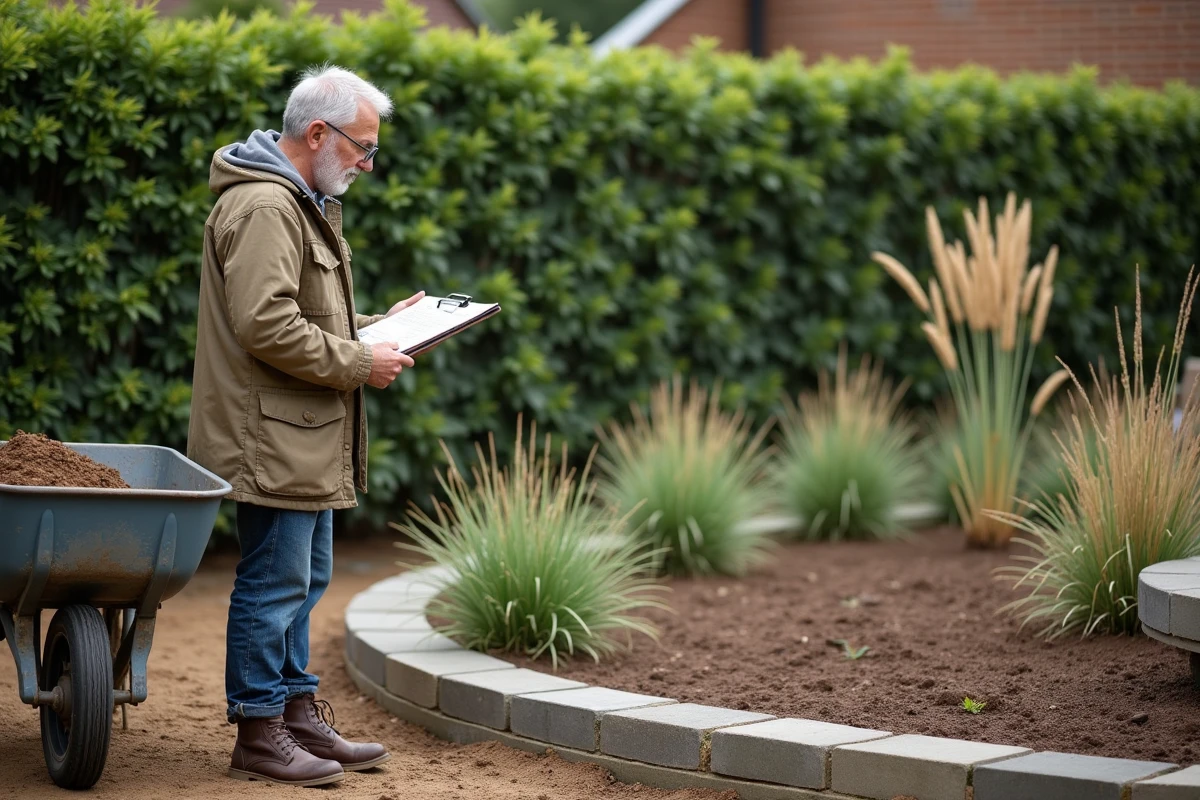
- Ornamental grasses (fescues, stipa) tolerate prolonged dry periods and structure a bed without regular watering
- Mediterranean shrubs (lavender, rosemary, cistus) thrive in calcareous or sandy soil, but less so in heavy, wet soil
- Ground-cover perennials like creeping thyme or yarrow reduce the area to be watered while limiting weeding
Installing a rainwater collector from the start of the project allows you to build a useful reserve during restriction periods. The sizing depends on the available roof area and local rainfall.
Mowing strategy and mulching: soil as a tool for sustainable design
The lawn is not just a decoration. Its management directly influences soil health, water consumption, and even the visual aspect of the garden. Professionals recommend maintaining a higher mowing height, around five to seven centimeters, rather than cutting the grass very short.
A taller lawn retains soil moisture better, limits weed growth, and is more resistant to heat episodes. Alternating mowing directions with each pass prevents compaction and encourages a denser growth.
Transforming cut grass into mulch
Dry grass collected after mowing can be used as mulch at the base of flower beds and vegetable gardens. This technique reduces evaporation, nourishes the soil as it decomposes, and measurably decreases the need for watering. It creates a virtuous cycle that transforms waste into a resource.
To ensure that grass mulch works without generating mold, spread it in a thin layer and let it dry for a day before applying. Mixed with fallen leaves or wood chips, it forms a balanced mulch that lasts for several weeks.
Garden automation: timers, solar lighting, and robotic mowers
Designing a garden as an automated space from the outset changes the game. Consumer automation solutions (watering timers, connected solar lighting, robotic mowers) allow you to enjoy the garden all summer without dedicating every weekend to it.
The watering timer, in particular, is no longer a gadget. Paired with a rain gauge, it adjusts cycles based on actual weather conditions and prevents waste. Solar lighting, on the other hand, requires no buried wiring, simplifying installation during the initial setup.
What automation does not replace
The available data does not allow us to conclude that automation eliminates all maintenance. A robotic mower handles regular mowing but does not trim borders or perform selective weeding. A timer waters but does not detect a sick plant.
- Plan a monthly manual inspection to check the health of the plants
- Check the watering nozzles at the beginning and end of the season to avoid leaks
- Reposition solar lighting if vegetation creates new shaded areas as it grows
Automation is a comfort lever, not a substitute for gardening. It frees up time from repetitive tasks to reinvest in actions that require observation.
A successful garden design relies on choices made in advance, not on corrections afterward. Prioritizing visible areas, anticipating water constraints, and integrating automation from the design stage creates an outdoor space that truly works day-to-day, season after season.