
A bouquet of lilies placed on the living room table, and after a few hours, the scent fills the entire room. Headaches, sore throat, feeling of suffocation: these symptoms are quickly associated with the toxicity of the flower. The smell of lilies raises a real question for sensitive individuals, cat owners, and anyone who wants to keep fresh flowers at home without risk.
VOCs and lily scent: what really happens in indoor air
Lilies are among the most fragrant flowers that can be placed indoors. This scent comes from volatile organic compounds (VOCs) emitted by the petals and stamens. These molecules disperse into the ambient air, especially in a poorly ventilated or heated room.
Research in environmental pulmonology has shown that these VOCs are not toxic in the strict sense. We are not talking about a poison that accumulates in the body. The mechanism is different: in some individuals, the mixture of these fragrant molecules triggers a hypersensitivity reaction, not poisoning.
In concrete terms, documented cases of poisoning caused solely by the scent of lilies are nonexistent. The incidents reported in toxicological literature always involve direct contact: ingestion of parts of the plant, prolonged handling of pollen, or contact with the sap. We can be reassured on this point, as detailed in a comprehensive file where the scent of lilies is toxic according to Domotica, clearly distinguishing between scent and poison.

Asthma, migraines, and rhinitis: profiles that react to lilies
If the scent does not pose a toxicological danger, it can present a real problem in daily life for certain profiles. Allergists have refined their recommendations on this topic in recent years.
Symptoms triggered by the scent
In individuals suffering from poorly controlled asthma or allergic rhinitis, the mix of pollen and lily scent can increase the frequency of attacks. Migraines are also observed in individuals prone to tension headaches or migraines with sensory aura.
Feedback varies on this point: some people can tolerate a lily in a large ventilated room, but not in a closed bedroom at night. The volume of the room, temperature, and air renewal play as much of a role as the flower itself.
Practical recommendations from allergists
For at-risk profiles, recent recommendations include limiting very fragrant flowers indoors, including lilies. Not because they are poisonous, but because they aggravate an already fragile condition.
- Avoid placing a bouquet of lilies in the bedroom or in a small room without ventilation
- Remove the stamens as soon as the flowers open to reduce the amount of pollen suspended in the air
- Prefer Asian lily varieties, which are significantly less fragrant than oriental lilies
- Ventilate the room at least twice a day if you want to keep a bouquet of lilies
For a person without respiratory history or particular sensitivity to odors, a bouquet of lilies poses no identified risk.
Lilies and cats: a real danger that does not come from the scent
The most widespread confusion concerns cats. It is often read that the scent of lilies can kill a cat. The reality is more nuanced, but the danger is indeed real.
The scent of lilies does not directly poison the cat. The fragrance may, however, attract the animal to the plant. And that is where the risk begins: ingestion of any part of the lily (leaf, petal, stem, pollen, vase water) can cause acute renal failure in felines.
Signs of poisoning in cats
The first signs generally appear within hours following ingestion:
- Repeated vomiting and loss of appetite in the first hours
- Lethargy, dehydration, and cessation of urine production
- Renal failure that can become irreversible without prompt veterinary care
The prognosis depends on the speed of intervention. Contact a veterinarian urgently at the slightest suspicion of ingestion remains the only course of action. Waiting for renal symptoms is often waiting too long.
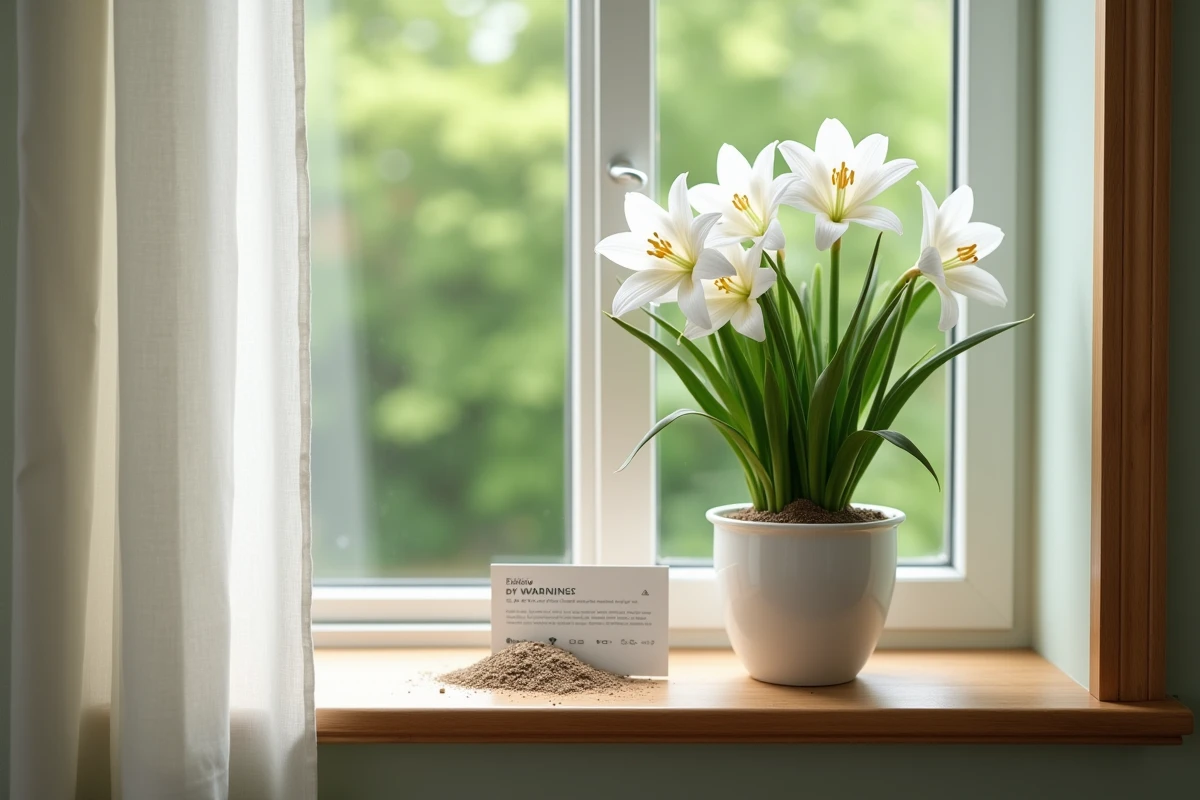
Are all varieties affected?
Varieties of the genus Lilium (oriental lilies, Asian lilies, trumpet lilies) are all considered dangerous for cats. Daylilies (Hemerocallis) also present a risk. In contrast, lily of the valley (Convallaria) or peace lily (Spathiphyllum), sometimes referred to as “lilies” by misnomer, belong to different botanical families and different types of toxicity.
For dogs, lilies are significantly less dangerous. Digestive disturbances are sometimes observed after ingestion, but not the mechanism of sudden renal damage described in cats.
Keeping lilies at home: practical considerations
The situation can be summarized in three simple scenarios.
If you live without a sensitive animal and without respiratory pathology, a bouquet of lilies in the living room poses no problem. Removing the stamens limits pollen on the furniture and reduces the intensity of the scent.
If you are prone to asthma, migraines, or rhinitis, it is better to choose low-fragrance lily varieties or place them in a well-ventilated room. Asian lilies are a good compromise: just as decorative flowers, discreet scent.
If you have a cat at home, the recommendation is categorical: do not introduce lilies, regardless of the type. The risk of renal failure is too high to be managed by simple height placement precautions. A curious cat almost always ends up accessing the plant.
The scent of lilies is not a poison. It is a potential irritant for sensitive respiratory tracts and, indirectly, a vector of risk for cats that it attracts to a plant that is, in fact, truly toxic through contact and ingestion.