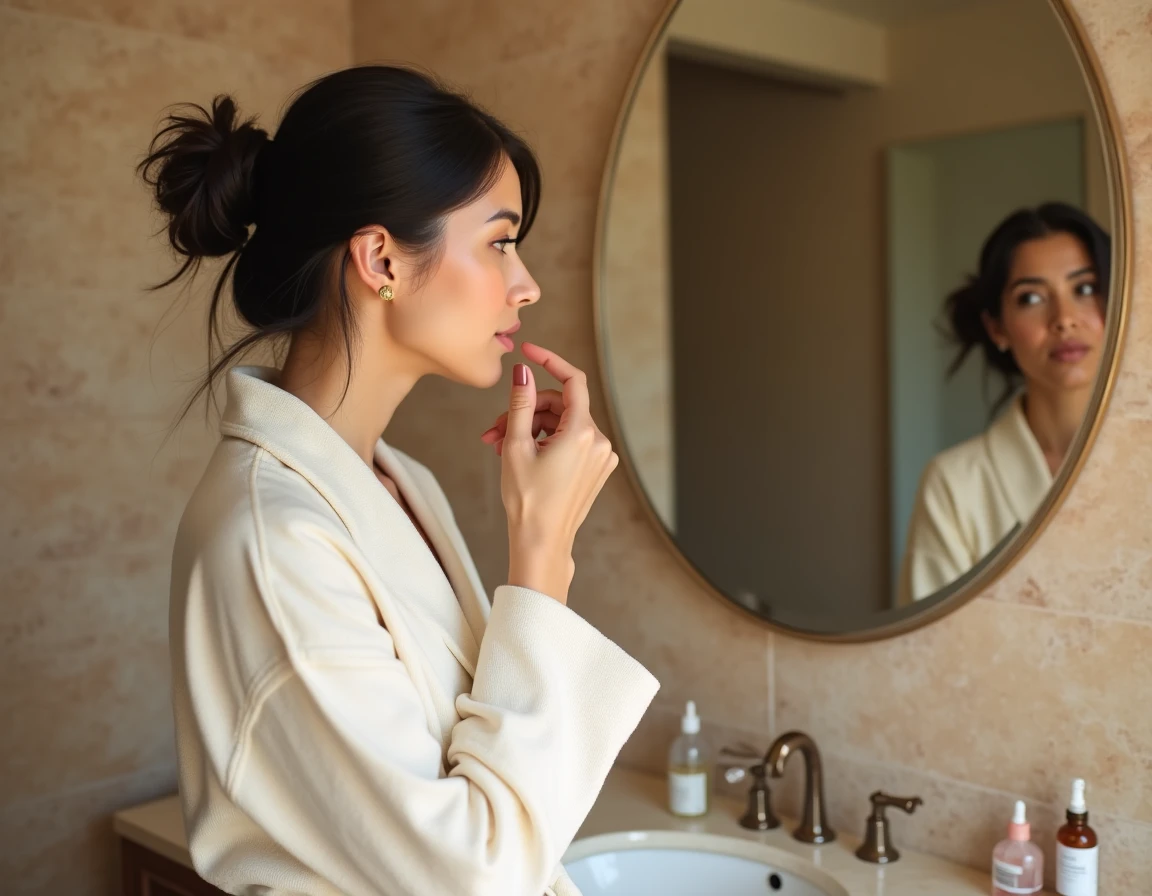
The daily beauty routine is undergoing a reassessment. Dermatologists are warning about excessive layering of serums and active ingredients, while brands continue to multiply the steps. The gap between marketing discourse and clinical recommendations is widening. Enhancing one’s beauty daily first requires understanding what truly works on the skin and what is merely a superfluous gesture.
Skin minimalism: why reducing your beauty routine changes the skin

The trend of skin minimalism has emerged as a direct response to the ten-step routines popularized by K-beauty. The principle is based on a shared observation by several dermatologists: layering too many products weakens the skin barrier. Irritations, cosmetic acne, increased sensitivity: the side effects of an overloaded routine are documented.
The minimalist protocol consists of three steps: a gentle cleanser, a moisturizer suited to the skin type, and daily sun protection. Nothing more, unless there is a specific need (active acne, hyperpigmentation). This approach does not mean giving up on active ingredients, but rather introducing them one by one over several weeks to observe the skin’s actual reaction.
Specialized resources like espace-beaute.net allow navigation among available products without succumbing to accumulation. Sorting remains the first beauty tip that produces visible results.
Adapting facial care to the seasons: what fixed routines overlook

A rich cream perfect in January can cause comedones in June. Seasonal periodicity of care is an underutilized lever in mainstream routines. The skin reacts differently to heat, cold, and humidity variations, which justifies adjusting textures and active ingredients throughout the year.
Spring and summer: lightness and protection
As heat and humidity increase, sebum production intensifies. A sulfate-free cleanser avoids irritating the skin while removing excess oil. For hydration, a lightweight serum based on hyaluronic acid or aloe vera is a better replacement for thick cream.
SPF remains the non-negotiable gesture, regardless of the weather. The optimal index varies according to phototype and actual exposure, but a broad-spectrum sunscreen applied every morning covers most common situations.
Autumn and winter: repair and nourish
Cold, wind, and heating dry out the stratum corneum. Richer textures take their place: balm, vegetable oil, nourishing cream. A very gentle, spaced exfoliation helps with cell renewal without compromising the skin barrier.
- Replace gel cleanser with a milk or oil cleanser that preserves the hydrolipidic film
- Switch from a watery serum to a lightweight vegetable oil (jojoba, squalane) depending on skin tolerance
- Reduce the frequency of exfoliation: once a week is sufficient for most skin types
Nocturnal regeneration and circadian rhythm: when to apply your products matters as much as which ones
The skin does not function the same way in the morning and at night. At night, skin permeability increases and cell renewal accelerates. This circadian cycle has a direct consequence on the effectiveness of products: repairing actives penetrate the skin better between evening and midnight.
An anti-aging product or targeted serum applied in the morning loses some of its potential because the skin barrier is then in protection mode. In the evening, after thorough cleansing, the skin absorbs more. This is the time to introduce concentrated actives: retinol, peptides, low-concentration fruit acids.
Evening cleansing is the only truly non-negotiable gesture. Pollution residues, makeup, accumulated sebum: without this cleansing, the skin’s nocturnal regeneration is compromised, regardless of the product applied afterward.
Hair and facial glow: often neglected gestures that change the result
The glow of the face does not solely depend on the products applied to the skin. Two peripheral factors play a measurable role but are rarely addressed in standard routines.
The first concerns internal hydration. A dehydrated skin does not respond properly to creams and serums, regardless of their quality. Water consumed throughout the day helps maintain elasticity and radiance of the complexion. The consistency of water intake matters more than the sheer volume.
The second factor concerns the hair. Dull or damaged hair alters the overall perception of the face. A few adjustments yield quick results:
- Space out shampoos to preserve the natural sebum of the scalp, which protects the fiber
- Apply a leave-in treatment on the lengths after washing to limit breakage and add shine
- Use a heating device (hairdryer, straightener) at moderate temperature to avoid dehydrating the hair fiber
These simple gestures take only a few minutes and transform the overall appearance daily.
Daily beauty rests on a verifiable principle: fewer products, better chosen, applied at the right time. Adapting your routine to the season, respecting the skin’s circadian rhythm, and not neglecting internal hydration are three concrete levers that every routine can integrate starting next week.