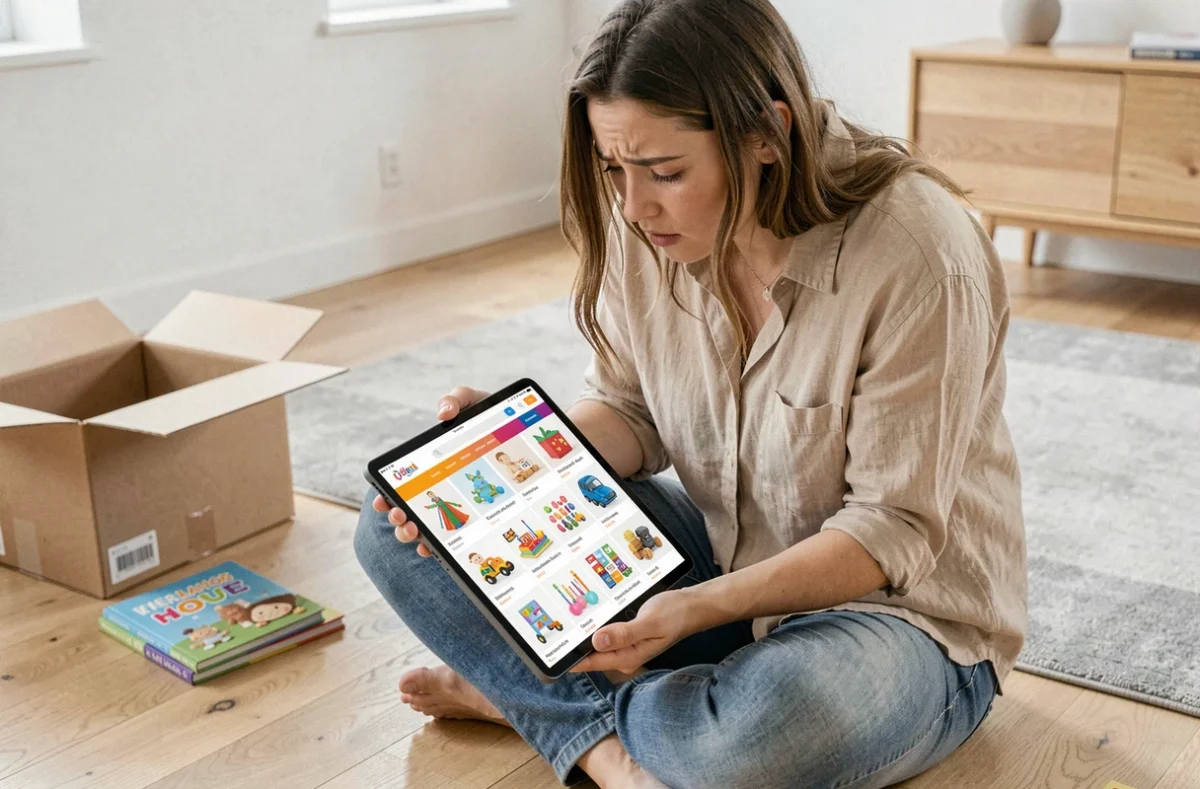
Buying clothing, a toy or an accessory for a child online rarely takes more than a few clicks. Sorting through the hundreds of products offered by online stores, however, can quickly become overwhelming. With seasonal collections, age ranges, safety standards and the growing number of sellers on marketplaces, knowing where to look and what to check can make all the difference to your purchase.
Online product listings for children: what to check before placing an order
Before comparing prices or styles, the product listing is your first reliable filter. On a reputable website, it should offer more than just a photo and an “Add to cart” button.
The European Toy Safety Directive requires safety warnings to be visible before purchase, not just on the packaging received at delivery. The European General Product Safety Regulation extends this requirement to online listings. If a listing gives no age limit, product composition or manufacturer details, consider it a red flag.
Have you noticed that the same toy can appear on several platforms with very different listings? One shows the standards, while another does not. Always choose the most complete listing. Also check who is selling the product: the website itself or a third-party seller hosted on its marketplace.
Inspections reported by the DGCCRF have highlighted particular risks associated with toys offered by certain marketplaces, making it important to clearly identify the seller and manufacturer before placing an order.
To browse a catalogue organised by category (clothing, toys, baby care, accessories), the Moon Kidsstore.be website offers a site structure that lets you filter products by theme and type, making it easier to find a specific item.

Filter by age, collection or use: which search method should you choose?
Online stores for children organise their catalogues in three main ways. Understanding the logic behind each method can save you time.
Filtering by age range
This is the most common and useful filter for toys and baby care products. A toy suitable for an 18-month-old is not appropriate for a 6-month-old baby, and the age limit is more than a suggestion: it often reflects a safety requirement, such as small parts or mechanical strength.
Always filter by age before looking at the price. This immediately rules out unsuitable products and narrows the catalogue down to a manageable selection.
Filtering by seasonal collection
Clothing retailers update their ranges several times a year. A spring-summer collection launched in March will be on sale in July. Buying at the start of a collection gives you the widest choice of sizes and colours. Buying at the end of a collection can mean discounts, but popular sizes sell out quickly.
Why does this choice matter so much? Because children grow quickly, and clothes bought too early may be too small by the time they are ready to wear them. Sometimes it is better to wait for a new collection to launch than to stock up in advance.
Filtering by use
Some stores group their products by situation: “sleep”, “mealtimes”, “play”, “outings”. This works well when putting together a baby registry or looking for a gift without a specific idea in mind. It can also help you discover categories you might not have thought to search for.
Quality and prices of children’s products: practical points of comparison
Comparing prices between two websites is not enough if the products differ in quality or compliance. Here are some useful points to compare:
- The composition and origin of materials (organic cotton, recycled polyester, certified wood) should normally be listed on the product page. If this information is missing, take note—especially for items that come into contact with a baby’s skin.
- The CE marking on toys sold in Europe indicates that the manufacturer declares the product meets the applicable safety requirements. It is not an absolute guarantee, but if the marking is not mentioned on the product page, that is reason enough to move on to another product.
- Verified customer reviews can help you spot recurring issues (inaccurate sizing, pilling fabric, fragile parts). Prioritise negative reviews: they are the ones that reveal specific flaws.
- Return costs and exchange policies vary from one website to another. A low price loses its appeal if returns are costly and complicated.

Product recalls and safety alerts: a habit worth adopting
The French government website RappelConso regularly publishes recall notices for children’s products, including toys and clothing. These recalls are issued after products go on sale, sometimes several months after purchase.
Checking RappelConso after an online purchase is a simple step that takes less than a minute. You can search by product category, and the site lists the exact products affected, the reason for the recall and what to do next.
Regulation (EU) 2025/2509 will eventually introduce a digital product passport to make it easier to track each item. Until it is implemented, sellers’ obligations regarding traceability and information continue to evolve. For parents, the practical approach is to keep a record of the product details (brand, model and batch number, if provided) so you can quickly check whether it is affected by a recall.
Browsing online collections and products for children does not require you to become an expert in regulations. Three checks are enough to avoid most unpleasant surprises: read the product listing beyond the photo, filter by age before anything else, and keep a record of what you ordered. The rest comes down to personal taste.